

Introduction
Why Manual Media Buying Is Breaking Down
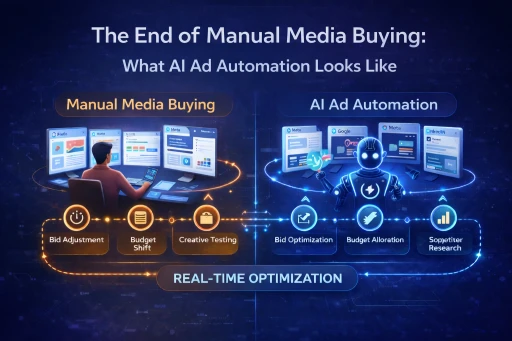
What AI Ad Automation Actually Does
How AI Changes the Paid Media Workflow
Conclusion
Copy link


Quick answer
AI-powered ad automation replaces manual tasks like bid adjustments, budget shifts, and report building with coordinated AI agents that work in real time, across every channel, without stopping. The result is faster campaigns, lower costs, and more time for the strategic thinking that actually drives growth.
Introduction
If you have ever spent a Tuesday night adjusting bids, duplicating ad sets, and second-guessing every budget split, you already know the truth: manual media buying is exhausting. It is slow. It does not scale. And in 2026, it is quickly becoming a thing of the past.
This is not a story about robots taking jobs. It is a story about a better way to work — one where AI handles the repetitive, time-consuming parts of paid advertising so you can focus on the decisions that actually matter.
Let's break down what is really changing, what AI-powered ad automation actually does, and why the shift is happening faster than most teams expected.
Why Is Manual Media Buying a Problem in 2026?
Manual media buying made sense when digital advertising was simpler. You picked a platform, set a budget, chose an audience, wrote some copy, and let it run. Easy enough.
But the job has gotten much harder. Today, a single campaign might involve dozens of ad sets, hundreds of creative combinations, multiple platforms, and thousands of daily bid decisions. Meta's ad auction alone evaluates over 10,000 data points in milliseconds to decide who sees your ad. Google's smart bidding systems adjust bids in real time based on signals no human could ever track manually.
Here is the core problem: the platforms have gotten smarter, but the workflows at most companies have not.
A 2025 IAB study found that 80% of ad buyers are already using or actively exploring AI tools for media planning and activation — and the main reason is time. Teams realized they were spending hours every day on tasks a machine could do better. According to industry data, the average marketing manager spends four to six hours building a single campaign that could theoretically launch in under thirty minutes with the right tools.
What kinds of tasks eat up all that time?
Building and duplicating campaign structures across platforms
Testing creative variations one at a time
Shifting budgets between ad sets based on performance
Pulling data from five dashboards and building reports by hand
Monitoring campaigns for problems while juggling everything else
That is not strategy. That is administration. And it is a problem AI was built to solve.
What Does AI-Powered Ad Automation Actually Do?
When people hear "AI-powered advertising," they often picture a black box — something that makes mysterious decisions and leaves you guessing. That is a fair concern. But good AI ad automation does not work that way. It works with you, not around you.
Here is what modern AI handles well:
Real-time bid and budget optimization. AI looks at thousands of signals at once — device type, time of day, audience behavior, auction competition — and makes bidding decisions in milliseconds. No human can do that at scale. The result: less wasted spend and better returns without constant manual adjustments. Research shows that brands using multi-touch attribution and real-time optimization see ROAS improvements of 10–35%
Creative testing at speed. Instead of running one A/B test at a time, AI can test many creative variations at once and automatically shift budget toward what is working. Headlines, images, calls to action — the system learns what your audience responds to and keeps improving. Creative testing alone has been shown to increase ROAS by 18–45%
Cross-channel coordination. Keeping campaigns aligned across Google, Meta, TikTok, and other platforms is genuinely hard to do manually. AI tracks performance across all of them and rebalances your budget in real time based on where you are getting the best return. Multi-channel campaigns consistently outperform single-channel by 23–45%
Smarter reporting. Instead of building reports by hand, AI surfaces the insights that actually matter — and flags problems before they become expensive. One real-world agency cut client report-building time by 20% simply by adding an AI reporting agent to its workflow
Competitor research. Some AI platforms analyze what competitors are doing in the market before you even launch a campaign, so you start with an advantage instead of guessing.
What AI does not replace is your judgment. Strategy, brand voice, creative direction, and knowing your customer — those still belong to you. The best AI tools handle execution so you can spend more time thinking.
What Is Agentic AI, and Why Does It Matter for Paid Media?
Quick answer: Agentic AI goes beyond simple automation. Instead of following fixed rules, it takes sequences of actions to complete a goal — analyzing data, reallocating budget, testing creative, and updating reports, all without waiting for a human to trigger each step.
Think of it this way. A basic automated rule says: "Pause this ad if CPA goes above $50." An agentic system says: "This campaign is underperforming. I will analyze the data, find the issue, reallocate the budget, test a new creative angle, and update your report."
Real-world results back this up. In December 2025, agency Butler/Till ran the first fully autonomous CTV campaign using agentic AI. The results: an 87% reduction in setup time and 70% faster issue resolution. In a separate test, Viant's agentic AI system achieved a $15 cost per action on one campaign — compared to $45 using human traders.
These are not small differences. They represent a fundamental shift in what a lean marketing team can accomplish without adding headcount.
What Does an AI-Powered Ad Workflow Look Like End to End?
Let's trace a real workflow to make this concrete.
In a traditional setup, a paid media specialist spends two or three hours researching competitors, another hour building campaign structure, more time writing copy for each ad variation, and then monitors performance throughout the week — making adjustments by hand whenever something shifts. It is a lot of hours on execution and very little on strategy.
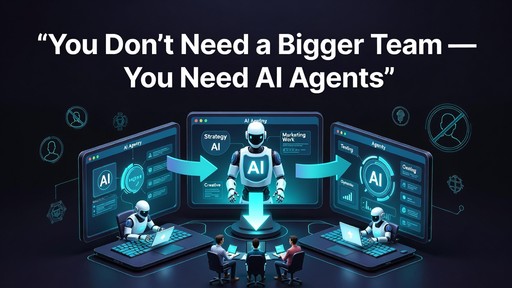
With an AI-powered platform like Scalable, that same workflow looks completely different. Scalable's coordinated AI agents handle everything from competitor research and creative generation to structured testing, real-time budget optimization, and reporting — all inside one connected workflow. The specialist reviews what the system builds, gives direction and feedback, and focuses their energy on strategy rather than setup.
This is not about removing people from the equation. It is about changing what people spend their time on. When AI handles the execution layer, your team works at a higher level — more creative thinking, more strategic planning, more time understanding the customer.
That is the shift that matters.
What Do Teams Get Wrong About Ad Automation?
There is a common myth worth addressing: that AI-powered advertising means "set it and forget it." It does not.
Automation amplifies your strategy. If your strategy is unclear, automation amplifies the wrong things — faster and at more scale than manual work would. The teams that see disappointing results from AI tools are often the ones who handed over execution without first defining what success looks like.
The teams winning with AI automation in 2026 are the ones who invest in clear goals, good data, and strong creative concepts — and then let AI handle the rest. They stay involved. They review performance. They course-correct when needed. But they are not spending six hours building a campaign that could have launched in thirty minutes.
Is the Gap Between AI and Manual Teams Growing?
Yes — and faster than most people expect.
Faster testing means faster learning. Faster learning means better performance. Better performance means more budget confidence. It compounds over time, and the teams that start building these systems now will have a significant head start on the ones that wait.
In 2026, AI is not experimental in paid media. According to the IAB's 2025 Outlook Study, 80% of ad buyers are already using or exploring generative AI for media planning and activation. Platforms like Google, Meta, TikTok, and Disney are racing to integrate AI deeper into every part of their ad ecosystems — Disney has publicly committed to 75% automated advertising by 2027.
The question is not whether automation is coming. It is already here. The real question is whether your team is built to take advantage of it.
Frequently Asked Questions
What is AI-powered ad automation?
AI-powered ad automation uses artificial intelligence to handle the repetitive tasks in paid advertising — things like bid adjustments, budget shifts, creative testing, and reporting. Instead of doing these by hand, AI agents handle them in real time, across every channel, around the clock.
How is agentic AI different from regular ad automation?
Regular automation follows fixed rules you set in advance. Agentic AI takes goal-directed sequences of actions — it can analyze a problem, decide what to do, act on it, and report back, all without waiting for a human to trigger each step.
Does AI replace paid media managers?
No. AI handles execution tasks — bid management, budget pacing, creative rotation, reporting. Strategy, brand direction, creative judgment, and customer understanding still require human thinking. AI frees up paid media managers to do more of that high-value work.
What results can I expect from AI-powered paid media?
Results vary by account and industry, but research points to 10–35% ROAS improvement from real-time optimization, 18–45% ROAS lift from structured creative testing, and setup time reductions of up to 87% with agentic workflows.
Where do I start with AI ad automation?
Start by identifying where your team spends the most time on repetitive tasks. Budget pacing, creative testing, and reporting are common starting points. Look for platforms that are transparent about how their AI works and keep you in control of the decisions that matter most.
We help to grow fast, so get started
shaan@kouo.io