

Introduction
Why Competitor Ad Research Matters
Where to Find Competitor Ads
Turn Insights Into Campaign Tests
Conclusion
Copy link


Short Answer
Competitor research for ads is the process of analyzing the paid ads competitors run across platforms like Meta, Google, TikTok, and LinkedIn. Marketers study ad copy, creative, run time, emotional hooks, and calls to action to understand what messaging and offers are working in their market before spending their own advertising budget.
Introduction
Competitor research for ads means studying what your competitors are running — what they say, how long they run it, and what emotion they trigger. Done right, it tells you what's working in your market before you spend a single dollar testing it yourself.
You spend hours every week clicking through ad libraries, saving screenshots, and building spreadsheets. By the time you pull it all together, your competitors have already launched three new campaigns.
Manual competitor ad research is one of the biggest time drains in performance marketing. And the worst part? Most teams aren't doing it in a way that leads to better campaigns.
This guide covers exactly how to research competitor ads faster, what to look for, how to turn insights into action, and why AI is changing the game for performance marketers and agency owners tired of doing everything by hand.
Why Does Competitor Ad Research Actually Matter?
Every ad your competitor keeps running for 30, 60, or 90 days is a signal that something is working. Studying those ads gives you free market intelligence before you spend a dollar of your own budget finding out.
Your competitors are running tests every day. They're spending real money to learn what messages land, what formats convert, and what offers close. When you study their ads, you get that knowledge for free.
The results are real. According to Crayon's 2024 State of Competitive Intelligence report, 67% of businesses say competitive intelligence directly helps them win more deals. And companies with a formal competitive intelligence function close deals at meaningfully higher rates than those without one.
But most teams are stuck collecting ads without extracting any useful insight. They save screenshots, forget about them, and never change a single campaign because of it.
This guide will move you from passive collecting to active testing — where research connects directly to experiments, and experiments connect directly to growth.
What Is the Problem With Manual Competitor Research?
Manual competitor research is slow, incomplete, and rarely leads to action. Most teams check one or two platforms, collect a few screenshots, and never build anything actionable from what they find.
Here's how most performance marketers do competitor research today:
Open Meta Ad Library
Search for a competitor
Scroll through ads, screenshot a few
Maybe check Google's Ads Transparency Center
Try to remember to do it again next week
This process has three big problems.
It's slow. Jumping between platforms, searching by name, filtering by date — it eats up hours that should go toward launching and optimizing campaigns. According to HubSpot's 2024 State of Marketing report, marketers spend an average of 12 or more hours per week on manual, repetitive tasks that could be automated.
It's incomplete. Your competitors are running ads on Meta, Google, TikTok, LinkedIn, and more. Checking each platform by hand means you're always missing something.
It doesn't lead to action. A folder of screenshots is not a strategy. Without a system to turn insights into tests, the research is mostly wasted.
The solution isn't to stop doing competitor research. It's to do it smarter.
Step 1: How Do You Build the Right Competitor List?
Start with 6 to 10 competitors organized into three rings: direct competitors (3–5), budget competitors (2–3), and aspirational competitors (1–2). More than 10 becomes noise. Fewer than 6 and you won't spot patterns.
Before you research anything, you need to know who you're actually watching. Most teams track too many competitors or the wrong ones.
Ring 1 — Direct competitors. Same product, same customer, same price range. Pick 3 to 5. These are the brands your customers compare you to when making a buying decision.
Ring 2 — Budget competitors. Different product, same problem. They're not selling what you sell, but they're competing for the same customer budget and attention. Pick 2 to 3.
Ring 3 — Aspirational competitors. Bigger brands in your space (or adjacent spaces) that are exceptional at advertising. Pick 1 to 2. You're not copying them — you're learning from the best.
That's 6 to 10 competitors total. More than that becomes noise. Fewer than 6 and you won't spot patterns.
How to find your Ring 1 competitors:
Pull your last 50 lost deals from your CRM. Which competitor names came up most?
Search your top 5 buying-intent keywords in an incognito window. Who's running ads?
Follow your own brand pages on LinkedIn and Instagram. Who does the algorithm suggest as similar? That's who shares your audience.
Brands that show up in two or more of these searches are your true Ring 1 competitors.
Step 2: Where Should You Look for Competitor Ads?
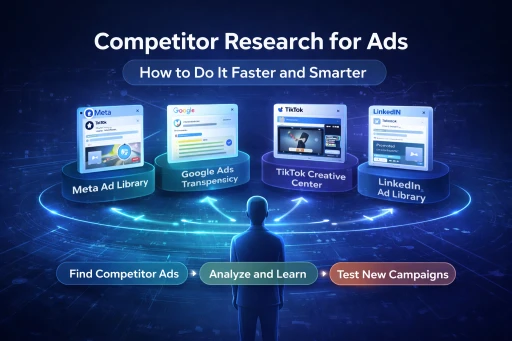
The four best free tools for competitor ad research are the [Meta Ad Library](https://www.facebook.com/ads/library), [Google Ads Transparency Center](https://adstransparency.google.com/), [TikTok Creative Center](https://ads.tiktok.com/business/creativecenter/), and [LinkedIn Ad Library](https://www.linkedin.com/ad-library/). Each shows different ad types and different performance signals.
Every major ad platform has a free public tool to see what competitors are running. Here's what each one gives you:
[Meta Ad Library](https://www.facebook.com/ads/library/) — The most useful free tool available. Search any brand to see every active ad running across Facebook, Instagram, Messenger, Audience Network, and Threads. Use the Page ID search method (not just the brand name) to capture all regional pages. Ads running 30 or more days are almost certainly profitable — brands don't keep spending on ads that lose money.
[Google Ads Transparency Center](https://adstransparency.google.com/) — Search a competitor's domain to see their search, display, and YouTube video ads. The "first seen" and "last seen" dates reveal what they've committed to long-term — your strongest signal for what's working in search and display.
[TikTok Creative Center](https://ads.tiktok.com/business/creativecenter/) — Filter by industry to see top-performing ads. Unlike other platforms, TikTok shows actual performance signals: view counts, CTR ranges, and engagement metrics. This is the only free tool that shows you what's winning, not just what's running.
[LinkedIn Ad Library](https://www.linkedin.com/ad-library/) — LinkedIn launched a public Ad Library in 2023. Search any company by name to see their active sponsored content, copy, and creative formats. It's especially useful for B2B advertisers studying competitor messaging and offers.
The problem? Jumping between all four of these every week is slow and easy to skip. That's exactly where smart tools make the biggest difference.
Step 3: What Tools Make Competitor Research Faster?
Tools that aggregate competitor ads across platforms, track run times, and alert you to new launches can cut weekly research from 45 minutes down to 15–20 minutes. AI-powered platforms go further — they turn those insights directly into action.
Manual research works fine if you have one or two competitors and a lot of time. For everyone else, the right tool makes a significant difference. Here's what to look for:
Does it cover the platforms you actually run on?
How fresh is the data? Daily updates beat weekly.
Does it capture full creatives and landing pages, not just headlines?
Can it flag how long each ad has been running?
AI-powered platforms like [Scalable](https://scalable.ad) go a step further. Instead of just showing you what competitors are running, Scalable's AI agents scan competitor ads as part of a continuous workflow. Those insights feed directly into creative generation, campaign structure, and budget decisions — all in one place. You're not just informed about what competitors are doing. You're already acting on it.
That's a fundamentally different approach from downloading screenshots and building a spreadsheet. The research and the doing are connected from the start.
Step 4: What Should You Actually Look for in a Competitor Ad?
When analyzing a competitor ad, focus on five things: run time, emotion, value proposition, objections handled, and call to action. Together, these tell you what your shared audience responds to — and where the gaps are.
Collecting ads is the easy part. Knowing what to do with them is the skill. Don't just ask "does this look good?" — run every ad through these five questions:
How long has it been running? Ads that run for 45 or more days are almost certainly profitable. Brands don't keep spending on ads that lose money. That run time is your strongest signal.
What emotion is it triggering? Most high-performing ads hit one of these: frustration ("tired of doing X by hand?"), aspiration, fear of missing out, or curiosity. Knowing which one your competitors lean on tells you what your audience responds to.
What's the value proposition? If you could only keep 10 words from this ad, what would they be? That's the core promise. Compare that across your competitor list and you'll quickly see where everyone is saying the same thing — and where there's a gap you can own.
What objections are they handling? "No credit card required." "Set up in 5 minutes." "Cancel anytime." Every line like this is a window into what your shared audience is worried about.
What's the call to action? "Learn More" is top of funnel. "Start Free Trial" is mid-funnel. "Buy Now" is bottom of funnel. Where your competitors focus tells you where they're investing — and where they're not.
Step 5: How Do You Turn Competitor Insights Into Real Tests?
For every insight you find in competitor research, write down one test you could run — with a specific launch date. Research without action is just interesting. Research with a test attached is growth.
This is where most teams drop the ball. They do the research. They notice things. And then nothing happens.
The fix is simple: for every insight you find, write down a test you could run. Not someday — with a launch date.
A simple scoring system helps. For each potential test, rate it on three things: how big the impact could be, how confident you are it will work based on competitor evidence, and how easy it is to launch. Add the scores and prioritize the highest ones first.
Quick wins — a copy tweak, a new CTA, a different hook — should go live within a day or two. Bigger tests like new video creative or a redesigned landing page take longer, but they should still have a deadline.
The goal is a 2:1 ratio: for every 2 hours you spend researching, you launch at least 1 test. Research without action is just interesting. Research with action is growth.
Step 6: How Do You Build a Research Rhythm You'll Actually Stick To?
The teams that get the most from competitor research aren't the ones who do the deepest analysis. They're the ones who show up consistently. Less than 2 hours a month is enough — if you have a system.
A simple weekly rhythm looks like this:
Monday (15–20 minutes): Check Ring 1 competitors for new ads. Flag anything that's been running 30 or more days. Note any new campaigns.
Bi-weekly (30 minutes): Do a deeper look at 1 to 2 high-priority competitors. Analyze messaging, creative formats, and offers.
Monthly (45 minutes): Look across your full competitor list for patterns. What's changing? What's everyone doing? What's no one doing?
That's it. Less than 2 hours a month of focused research can meaningfully change how you build campaigns — if you're turning insights into tests.
How Does AI Change Competitor Ad Research?
AI-powered platforms now monitor competitor ads continuously, surface the insights that matter, and connect them directly to your campaign workflow — replacing hours of manual work with a system that acts on what it finds.
The biggest shift in competitor research right now is AI automation. Instead of manually checking ad libraries and building spreadsheets, AI platforms can monitor competitors across channels in real time, flag what's working, and plug those insights directly into creative generation and budget decisions.
This is exactly what [Scalable](https://scalable.ad) is built for. It uses coordinated AI agents to handle the full digital ad workflow — including competitor research — so performance marketers and agency owners can spend less time on manual tasks and more time on strategy. Competitor insights flow directly into creative generation, structured experimentation, and real-time budget optimization across channels.
Instead of spending hours a week on research that may or may not lead to action, you get a system where the research and the doing are connected from the start. That's what "smarter" actually looks like.
What Are the Most Common Mistakes in Competitor Ad Research?
The four most common mistakes are treating run time as the only success signal, copying tactics without understanding why they work, ignoring your own campaign data, and doing research without attaching it to a specific test.
Thinking long-running means successful. An ad running for 60 days usually is performing well — but not always. Some brands have slow sales cycles or poor attribution. Look for multiple signals: long run time plus creative variations plus a consistent format across campaigns.
Copying tactics without understanding why. You see a competitor using carousels everywhere and switch all your campaigns to carousels. But maybe they use carousels because they have 50 products and you have 3. Borrow the principle, not the tactic.
Ignoring your own data. Competitor insights should inspire tests, not override what your own numbers already tell you. Your real campaign data always wins.
Doing the research but skipping the action. This is the most expensive mistake. If you're spending time on research, you owe it to yourself to let it change something.
Start This Week
You don't need a perfect system to start. Here's what you can do today:
Write down your 6 to 10 competitors, sorted into the three rings.
Spend 20 minutes in the Meta Ad Library looking at your top 3 Ring 1 competitors.
Find 2 ads that have been running 30 or more days.
Write down one test you could run based on what you see.
Set a launch date for that test.
That's competitor research that actually leads somewhere.
If you want to skip the manual parts and let AI handle the research so you can focus on strategy, Scalable is built exactly for that — automating the full ad workflow from competitor insights to campaign execution, in one place.
The brands winning right now aren't more creative or better funded. They're better informed. And increasingly, they're letting AI do the work that used to take hours.
You can too.
Frequently Asked Questions
What is competitor research for ads?
Competitor research for ads is the process of systematically studying the paid ads your competitors run across platforms like Meta, Google, TikTok, and LinkedIn. It involves analyzing what they say, how long each ad runs, what emotions or offers they lead with, and what calls to action they use. The goal is to learn what is already working in your market — what messages land, what formats convert, and what offers close — before spending your own budget to find out.
What are the best free tools for competitor ad research?
The four best free tools for competitor ad research are:
[Meta Ad Library](https://www.facebook.com/ads/library/) — See every active ad any brand is running across Facebook, Instagram, Messenger, Audience Network, and Threads. Free, no login required.
[Google Ads Transparency Center](https://adstransparency.google.com/) — Search any competitor's domain to see their active Search, Display, and YouTube ads, including first seen and last seen dates.
[TikTok Creative Center](https://ads.tiktok.com/business/creativecenter/) — The only free tool that shows actual performance signals (view counts, CTR ranges, engagement) filtered by industry.
[LinkedIn Ad Library](https://www.linkedin.com/ad-library) — Search any company to see their active sponsored content and copy. Most useful for B2B advertisers.
How do I know if a competitor ad is actually working?
The strongest signal that a competitor ad is working is run time. If a competitor has been running the same ad for 45 days or more, it is almost certainly profitable — brands do not keep spending on ads that lose money. Additional signals include multiple creative variations of the same core concept (meaning they are testing and scaling it) and consistent formatting across campaigns over time.


We help to grow fast, so get started
shaan@kouo.io