

Introduction
What Does "Full Ad Workflow Automation" Actually Mean?
The 6 Stages of a Modern Automated Ad Workflow
What This Looks Like in Practice
Conclusion
Copy link


Short Answer
Full ad workflow automation uses AI agents to manage every stage of digital advertising — from competitor research and campaign strategy to creative generation, campaign launch, real-time optimization, and reporting. Instead of relying on disconnected tools and manual handoffs, automated workflows connect each stage so insights continuously inform the next step, allowing teams to launch campaigns faster, run systematic experiments at scale, and optimize performance in real time.
Introduction
If you've ever watched a campaign brief sit in a shared doc for two weeks before a single ad went live, you already know the problem. The modern advertising workflow is broken — not because people aren't working hard, but because the process itself was designed for a world that no longer exists.
Today, brands and agencies that are winning aren't just moving faster. They're removing the manual bottlenecks entirely. Gartner research finds that 65% of CMOs believe advances in AI will dramatically transform their role within two years
This guide walks through exactly how that works, what each stage looks like with automation, and how platforms like Scalable are making it possible to go from strategy to live, optimized campaigns without the traditional delays, errors, and fragmented tooling that slow teams down.
What Does "Full Ad Workflow Automation" Actually Mean?
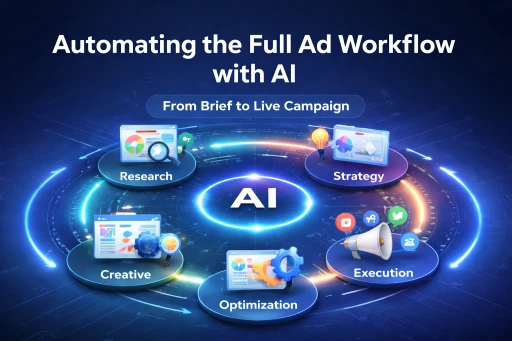
Full ad workflow automation means using AI — specifically coordinated AI agents — to handle every stage of the advertising lifecycle with minimal human intervention. That includes:
Research: Competitive intelligence, audience analysis, market signals
Strategy: Campaign structure, channel selection, budget allocation
Creative: Ad copy generation, visual ideation, format adaptation
Execution: Campaign building, cross-platform publishing, compliance checks
Optimization: Real-time budget reallocation, bid management, A/B testing
Reporting: Performance synthesis, actionable insights, next-step recommendations
This is fundamentally different from using individual automation tools duct-taped together. True end-to-end workflow automation means these stages are connected, with intelligence flowing from one to the next — so insights from reporting inform the next creative iteration, competitive research shapes campaign structure, and optimization data feeds back into strategy.
The result: fewer handoffs, less lag time, and campaigns that actually reflect what's working right now — not what worked last quarter.
The 6 Stages of a Modern Automated Ad Workflow
Stage 1: Competitor Research & Market Intelligence
Before any creative is touched, you need to know the landscape. What are competitors running? Which angles are saturated? What gaps exist in messaging?
Traditionally, this means a strategist spending days pulling ad libraries, screenshotting creatives, and building a manual comparison. With AI, a research agent can continuously monitor competitor ad activity across platforms, identify trending creative formats, and surface strategic gaps — all before a single line of copy is written.
What automation unlocks here:
Real-time visibility into what competitors are running
Pattern recognition across thousands of ads to identify what's resonating
Automated SWOT inputs that feed directly into campaign strategy
For teams using Scalable, competitor research is baked into the workflow from the start — so strategy is always grounded in current market data, not gut feel.
Stage 2: Brief-to-Strategy Translation
The brief is where it all begins. But most briefs sit in limbo between the brand/account team and the execution team, losing context with every handoff.
AI agents can ingest a campaign brief — including objectives, audience definitions, budget, and messaging pillars — and translate it directly into a structured campaign strategy. That includes recommended channel mix, audience segmentation, creative themes, and initial budget allocation, all mapped to the stated objective.
What automation unlocks here:
Instant translation from business brief to campaign architecture
Objective-aligned channel and budget recommendations
Reduced back-and-forth between strategy and execution teams
This is where speed compounds. When strategy generation takes hours instead of days, the entire downstream timeline accelerates.
Stage 3: AI-Powered Creative Generation
Creative is historically the biggest bottleneck. Briefs get stuck in review cycles. Designers are pulled in multiple directions. Copy goes through five rounds of revisions. And by the time it's approved, the campaign window may have passed.
AI-powered creative generation changes this entirely. With modern generative AI, you can produce:
Ad copy variations across tones, formats, and CTAs
Headline and description combinations for search and social
Visual concepts and image/video generation
Resized and reformatted assets across every placement spec
Crucially, the best implementations don't just generate volume — they generate brand-safe, on-brief creative that's structured for experimentation. Rather than picking one "winning" ad upfront, you launch with a structured matrix of variations designed to surface winners through real performance data.
What automation unlocks here:
Significantly faster creative production compared to traditional workflows — teams using AI-powered creative report 30–50% reductions in content production time (Cal State LA / University of San Francisco, 2025)
Systematic variation across messaging angles, formats, and audiences
Brand consistency at scale without manual QA on every asset
Scalable's creative generation is built specifically for performance — producing cross-channel, brand-safe creative that feeds directly into structured experimentation frameworks.
Stage 4: Structured Experimentation Across Platforms
One of the most under-leveraged advantages of automation is the ability to run systematic experiments at a scale that's simply impossible manually.
Most teams run a handful of A/B tests at a time. Automated experimentation frameworks can test dozens of variables simultaneously — audiences, creatives, placements, bidding strategies — and make allocation decisions based on early performance signals, not hunches.
What automation unlocks here:
Concurrent testing across audiences, creatives, and placements
Rapid learning cycles that compress weeks of testing into days
Data-driven budget allocation toward proven performers
This is where AI agents earn their keep. A human media buyer can manage a handful of tests at once. An AI agent can manage hundreds, continuously, across multiple platforms — without cognitive overload or missed signals.
Stage 5: Real-Time Budget Optimization
Budget management is one of the most time-sensitive tasks in paid media. CPCs shift by the hour. Audience behaviors change with the news cycle. A campaign that was efficient at 9 AM may be bleeding budget by 2 PM.
Traditional workflows rely on scheduled check-ins and manual adjustments. By the time a human reviews performance and makes changes, hundreds or thousands of dollars may have been wasted on underperforming placements. AI-optimized bidding delivers 10–20% average CPA improvement and 15–30% improvement in budget allocation efficiency for accounts with sufficient conversion volume (AI Marketing Statistics 2026).
Real-time AI budget optimization continuously monitors performance signals — cost per acquisition, ROAS, conversion rates, pacing — and reallocates spend dynamically toward what's working. It doesn't wait for the weekly review meeting. Real-world implementations back this up: one retail advertiser using AI-powered automation reduced CPA by 40% and improved off-season ROAS from 2.7x to over 5.0x by replacing manual budget reviews with continuous AI-driven reallocation.
What automation unlocks here:
Continuous budget reallocation based on live performance data
Defense against budget leakage during low-performance windows
Compounding efficiency as the system learns your audience and market patterns
According to McKinsey's *The Economic Potential of Generative AI*, generative AI could increase the productivity of the marketing function by 5–15% of total marketing spending
Stage 6: Actionable Reporting & Feedback Loops
Most reporting tells you what happened. The best reporting tells you what to do next.
Automated reporting agents don't just pull data and format dashboards — they synthesize performance across channels, identify patterns, flag anomalies, and surface specific, prioritized recommendations. When a creative is fatiguing, the system flags it and recommends a rotation. When a new audience segment is outperforming, it suggests budget reallocation.
This creates a true feedback loop: reporting outputs feed back into the research and creative stages, so every campaign cycle benefits from accumulated learning.
What automation unlocks here:
Instant, on-demand performance synthesis across all channels
Pattern recognition that surfaces insights humans would miss
Closed-loop learning that makes each campaign smarter than the last
Why Disconnected Tools Don't Cut It Anymore
Many marketers already use automation — but they're using it in silos. One tool for creative. Another for bidding. A third for reporting. A spreadsheet to tie it all together.
This fragmented approach creates its own problems:
Data loss between stages: Insights from reporting don't automatically inform creative strategy
Inconsistent execution: Each tool has its own logic, creating misaligned campaigns
Integration overhead: Connecting tools requires constant maintenance and often breaks
No cumulative learning: Disconnected systems can't build intelligence over time
The shift happening now — and what separates leaders from laggards in performance marketing — is the move to coordinated AI agent architectures. Multiple specialized agents, each expert in their domain, sharing context and working toward a unified campaign objective.
This is the model Scalable is built on. Rather than a patchwork of point solutions, it's a unified platform where research, creative, execution, optimization, and reporting operate as one connected system.
The Role of Coordinated AI Agents
The most important concept in modern ad workflow automation isn't any single AI feature — it's the coordination between agents.
Think of it like a high-performing campaign team:
Traditional Team Role | AI Agent Equivalent |
|---|---|
Strategist / Researcher | Competitor Research Agent |
Creative Director | Creative Generation Agent |
Media Buyer | Campaign Execution & Bidding Agent |
Data Analyst | Performance Monitoring Agent |
Optimization Manager | Budget & Bid Optimization Agent |
Reporting Lead | Insights & Recommendations Agent |
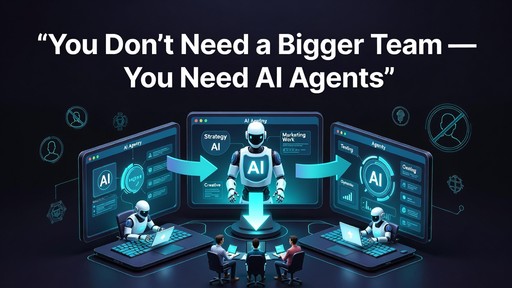
Each agent has deep expertise in its domain. The difference from a human team: these agents operate in parallel, 24/7, share data in real time, and improve continuously as they accumulate performance history on your specific brand, audience, and market.
Scalable's architecture is built around this principle — coordinated AI agents that handle the full workflow from brief to live campaign, with each stage feeding the next.
What This Looks Like in Practice
Here's a concrete example of how a campaign goes from brief to live using a fully automated workflow:
Day 1 — Brief received:
An AI research agent analyzes competitor activity, identifies audience signals, and generates a structured campaign strategy with channel mix and budget recommendations. A creative agent produces 30+ ad variations across formats and audiences.
Day 2 — Review & approve:
A human marketer reviews the strategy and creative output, makes adjustments, approves for launch. Total review time: a few hours, not weeks.
Day 3 — Live:
The campaign launches across platforms with a structured experimentation framework. Budget optimization agents begin monitoring performance immediately.
Ongoing — Continuous optimization:
Agents monitor performance in real time, reallocating budget toward winning segments, rotating creative as fatigue signals appear, and surfacing weekly recommendations.
End of cycle — Reporting & learning:
A reporting agent synthesizes findings, flags key learnings, and feeds insights back into the next campaign brief.
What once took 4–6 weeks from brief to live — a timeline consistent with industry benchmarks for campaign development that recommend "6–8 weeks minimum for significant campaigns" — and required a full team of specialists, now takes days, with a fraction of the manual work.
Key Benefits of Full Ad Workflow Automation
Dramatically reduced time to market
Campaigns that used to take weeks to launch can go live in days. AI handles the research, structuring, creative production, and setup — allowing teams to move at the speed of opportunity.
Fewer errors and less waste
Automated workflows remove the manual handoffs where errors accumulate — naming convention mistakes, incorrect targeting setups, misaligned creative specs. Less waste means more budget working toward actual results.
Systematic testing at scale
Instead of running two or three tests, automated experimentation runs dozens of concurrent experiments, accelerating the discovery of winning combinations.
Real-time optimization, not weekly reviews
Budget and bid optimization that happens in real time — not after the weekly review meeting — means better efficiency and less wasted spend.
Compounding intelligence
Every campaign adds to the system's knowledge base. Over time, AI agents become increasingly effective for your specific brand, audience, and competitive landscape.
Leaner teams, bigger output
Teams can manage more campaigns, more complexity, and more channels without linear headcount growth. The leverage is real: brands using AI-powered creative services have documented 3–4x more asset delivery compared to traditional agency workflows with the same internal team size (Forrester TEI, 2024).
How Scalable Powers the Full Workflow
Scalable is built specifically for this — an AI-powered advertising platform that automates the complete digital ad workflow through coordinated AI agents.
What Scalable handles:
Competitor research: Continuously monitors the competitive landscape so strategy is always informed by current data
Creative generation: Produces cross-channel, brand-safe ad creative designed for structured experimentation
Cross-platform execution: Manages campaign building and launching across channels without fragmented manual setups
Real-time budget optimization: Reallocates spend dynamically based on live performance signals
Actionable reporting: Synthesizes performance data into clear recommendations, not just dashboards
The key differentiator isn't any single feature — it's the coordination. Every stage feeds the next, so nothing gets lost between tools, teams, or review cycles. For brands and agencies looking to compete on speed and efficiency without sacrificing quality, Scalable turns the full ad workflow into a systematic, continuously improving engine.
Frequently Asked Questions
What is full ad workflow automation?
Full ad workflow automation refers to using AI — typically coordinated AI agents — to manage every stage of the advertising lifecycle, from competitor research and strategy formation through creative production, campaign launch, real-time optimization, and reporting. Rather than automating isolated tasks, it connects the entire process into one continuous, intelligent loop.
How does AI go from a brief to a live campaign?
AI agents ingest a campaign brief and translate it into a structured strategy, including channel selection, audience targeting, budget allocation, and creative direction. Specialized agents then generate ad creative, build campaign structures on the relevant platforms, launch the campaign, and immediately begin optimizing based on live performance data.
What are the biggest bottlenecks that automation removes?
The most common bottlenecks in traditional ad workflows include: waiting for competitive research, lengthy creative production and review cycles, manual campaign setup errors, delayed budget adjustments, and slow reporting turnarounds. AI automation addresses each of these by executing them faster, more accurately, and in a connected way.
How is AI campaign automation different from traditional marketing automation?
Traditional marketing automation follows predefined rules — if X happens, trigger Y. AI campaign automation uses machine learning and coordinated agents to reason about goals, adapt to changing conditions, and make decisions across multiple variables simultaneously. It's the difference between a thermostat and a smart climate system.
Is AI-powered ad automation suitable for agencies?
Yes — and agencies often see the largest efficiency gains. AI automation allows agencies to manage more client campaigns with the same team size, reduce production time dramatically, and deliver more consistent results. It also reduces the operational overhead of managing multiple platforms, creative cycles, and reporting workflows simultaneously.
What human oversight is still needed with automated ad workflows?
While AI handles execution and optimization, human judgment remains essential for strategy direction, brand voice approval, high-stakes messaging decisions, and interpreting broader market context. The best implementations use an 80/20 model: AI handles execution, humans guide strategy and review outputs. This combination maximizes both efficiency and quality.
How long does it take to see results from ad workflow automation?
Most teams see operational benefits — faster launches, reduced manual work — within the first few campaigns. Performance improvements (ROAS lift, CPA reduction) typically compound over time as AI agents accumulate performance data specific to your brand and market. Industry benchmarks suggest meaningful performance improvements are achievable with mature implementations: Meta's Advantage+ AI campaigns deliver an average 17% CPA reduction and 32% ROAS increase versus manual campaign structures (Meta, 2024), while AI bidding optimization delivers 10–20% CPA improvement across mature accounts (AI Marketing Statistics 2026).
What makes coordinated AI agents better than single automation tools?
Single automation tools optimize in isolation. Coordinated AI agents share context and data across the full workflow, so insights from one stage inform decisions in another. Reporting insights feed back into creative strategy. Competitive research shapes budget allocation. This closed-loop intelligence is what drives compounding improvements — something fragmented point solutions simply can't deliver.
How does Scalable differ from other ad automation platforms?
Scalable is built around a coordinated AI agent architecture that spans the full ad workflow — from competitor research to creative generation, cross-platform execution, real-time budget optimization, and actionable reporting. Unlike tools that automate individual tasks, Scalable connects every stage into one continuous system, ensuring nothing gets lost between platforms, teams, or review cycles.
Can small teams benefit from full ad workflow automation?
Absolutely. In fact, smaller teams often benefit most, since the leverage is proportionally larger. A two-person marketing team using Scalable can execute campaigns with the same quality and speed that previously required a full agency — and continuously improve performance through AI-driven optimization without additional headcount.
Ready to go from brief to live faster — and keep getting better with every campaign?
Learn more about End-to-End AI Ad Automation and Agentic Media Buying
Related Guides
Want to go deeper into end-to-end AI ad automation? Here are the most relevant guides from our library:
End-to-End AI Ad Automation Platforms in 2026: What Actually Works Compare today’s platforms and understand why true end-to-end automation is still rare.
What End-to-End Ad Automation Actually Looks Like in Practice See real-world examples of autonomous campaign execution and the performance gains brands are achieving.
What Is Agentic Media Buying? A Clear Framework for 2026 Understand the difference between traditional AI tools and true proactive, agentic systems.
How Scalable’s AI Agents Work: Turning Micro-Behaviors into Macro Performance Gains Dive into the mechanics of autonomous AI agents and how they convert small signals into major results.
Can I Use AI for True End-to-End Ad Optimization? Get an honest assessment of current capabilities and what’s realistically achievable with AI today.
Automating Ad Experiments with AI Agents for 10x Faster Wins Discover how agentic experimentation dramatically increases testing velocity and campaign performance.
We help to grow fast, so get started
shaan@kouo.io