

Introduction
Why Most Ad Testing Fails
How to Run a Structured Creative Test
Scaling Winning Ads Without Wasting Budget
Conclusion
Copy link


Short Answer
You want your ads to work. But how do you know which ads are best? You test them.
The problem? Testing can cost a lot of money. If you do it wrong, you waste your budget fast. And you don't learn much.
The good news? There's a better way. You can test your ads in a smart, structured way. You'll spend less money. And you'll learn what actually works.
This guide will show you how.
What Is Structured Creative Testing?
Structured creative testing is a method for testing your ads using clear rules and controls. You change one thing at a time. You set goals before you start. And you use data to pick winners.
This is different from random testing. With structured tests, you learn something useful every time. You don't just hope for the best. You follow a process that works.
Why Does Most Creative Testing Fail?
Let's start with the bad news. Most ad testing doesn't work well. Here's why. Some marketers test five things at the same time. A new image. A new headline. A new button. A new audience. A new platform. When the results come in, they don't know what worked. Was it the image? The headline? Both? Neither? It's impossible to tell.
No clear question. Good tests start with a question. "Will a video ad beat a static image?" That's a clear question. But many marketers just throw ads out there. They hope something sticks. This is called "spray and pray." It rarely works
Stopping too early. Sometimes an ad looks bad on day one. But by day five, it's winning. If you stop too early, you miss the winner. You need enough data to make a good call.
Stopping too late. The opposite is also true. Some marketers let bad ads run for weeks. They keep hoping things will turn around. They won't. That money is gone
No plan for success. What does "winning" even mean? More clicks? More sales? Lower costs? If you don't decide upfront, you'll argue about it later. And you won't learn anything useful
These mistakes are common. But they're also fixable.
A structured test has clear rules. Here's how to build one.
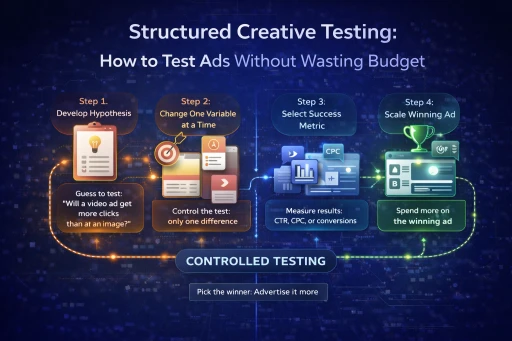
Step 1: Start With a Hypothesis
A hypothesis is a guess you can test. It sounds like this:
"I think a video ad will get more clicks than a static image."
Or:
"I think showing the product in use will beat showing the product alone."
Write it down. This keeps you focused. You're not just testing for fun. You're trying to answer a real question.
Step 2: Change One Thing at a Time
This is the golden rule. Only change one thing per test.
Let's say you want to test your headline. Keep everything else the same. Same image. Same audience. Same budget. Same platform. The only difference is the headline.
Now, when you see the results, you know what caused them. The headline.
This takes patience. You might want to test ten things at once. Don't. You'll learn more by going slow.
Step 3: Pick Your Success Metric
Before you launch, decide how you'll measure success. Pick one main metric.
Common options:
Click-through rate (CTR)
Cost per click (CPC)
Conversion rate
Cost per acquisition (CPA)
Return on ad spend (ROAS)
Different goals need different metrics. If you want awareness, look at CTR. If you want sales, look at CPA or ROAS.
Write it down. Stick to it.
Step 4: Set Your Budget and Timeline
For more on picking the right metrics for your goals, see our guide to ad performance metrics.
Decide before you start. This stops you from pulling the plug too early. It also stops you from wasting money on a losing ad.
A good rule: let your test run until you have enough data. According to Meta's guidelines, aim for about 50 optimization events (like conversions) per ad set per week. Google recommends running tests for 7–14 days to gather meaningful data. These aren't hard rules, but they help you avoid stopping too early.
Now let's talk money. How should you split your ad budget?
The 70/20/10 Rule (A Practitioner Best Practice)
This is a field-tested framework that many marketers use. It's not an official platform rule. It's a best practice that works well in the real world.
Now let's talk money. How should you split your ad budget?
This is a field-tested framework that many marketers use. It's not an official platform rule—it's a widely-adopted practitioner best practice that works well in the real world.
70% goes to your proven winners. These are ads that already work. Keep them running.
20% goes to iterations. These are small tweaks to your winners. A new headline. A different color. Small changes.
10% goes to wild cards. These are big, bold experiments. New formats. New angles. New ideas.
This keeps your results stable. Most of your budget goes to what works. But you're always testing new things too.
For a deeper dive into budget planning, check out our ad budget optimization guide.
How much do you need to run a real test? It depends on the platform.
For Facebook and Instagram, a common practitioner guideline is to budget $50–100 per ad variation to exit the learning phase—though this varies based on your cost per result. For Google Ads, similar principles apply. For TikTok, you might need more because costs vary widely. Check Google's campaign guidance for current benchmarks. (Note: Meta's pricing page requires a login to access.)
Frequently Asked Questions
When Should You Kill a Test?
Here's a best practice many marketers follow: if an ad is 50% worse than your control after reaching statistical significance, kill it. Don't wait for a miracle. This isn't an official rule—it's a practical guideline based on experience.
But give it time first. Follow the platform guidelines above (7–14 days for Google, enough events to exit the learning phase for Meta). Then make the call.
How Do You Build an Iteration Loop?
Your winner isn't the end. It's the beginning.
Ask: what made this ad work? Was it the hook? The visual? The offer? Now test variations of that winner. Can you make it even better?
This creates a flywheel. Each test teaches you something. Each lesson makes your next test smarter.
Learn more about building a testing flywheel in our creative testing playbook.
How Does Automation Change the Game?
Everything we've talked about takes time. A lot of time.
You have to set up tests. Watch the data. Make decisions. Move budgets. Repeat.
What if software could do most of this for you?
Real-Time Budget Shifting
AI can watch your ads around the clock. When one ad starts winning, it gets more budget. When one starts losing, it gets less. This happens automatically. No waiting. No manual work.
Faster Creative Iteration
AI can also help you make new ads. It can suggest headlines. Generate images. Create variations. What used to take days now takes minutes.
More Tests, Less Work
The result? You can run more tests in less time. You learn faster. You waste less money. And you find winners sooner.
This is where the industry is heading. Manual ad management is slow and expensive. Automation is fast and efficient.
What's the Bottom Line?
Structured creative testing isn't complicated. But it does require discipline.
Start with a clear question. Change one thing at a time. Pick your success metric. Set your budget and timeline. Use the 70/20/10 rule. Kill losers fast. Scale winners slow. And keep iterating.
Do this, and you'll stop burning your budget on bad tests. You'll learn what works. And you'll grow faster.
Want to see how AI can automate this entire process? Scalable helps brands and agencies run structured creative tests at scale—without the manual work. Check it out at scalable.ad



We help to grow fast, so get started
shaan@kouo.io