

Introduction
Quick Answer
What AI Ad Optimization Actually Means in 2026
The Modern AI Ad Optimization Stack
Conclusion
Copy link


Quick Answer
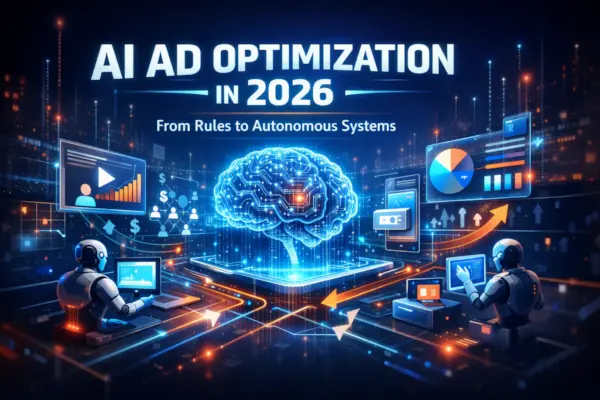
AI ad optimization in 2026 is no longer about automated bids, rules, or dashboards. The highest-performing teams are deploying agentic systems that continuously learn, test, and reallocate spend across creative, audiences, and channels in real time—without waiting for humans to intervene after performance drops.
Why “AI Ad Optimization” Meant Something Very Different Five Years Ago
For most of the last decade, AI in advertising meant one of three things:
Automated bid strategies
Rules-based budget reallocation
Predictive audience targeting
These systems helped reduce manual work, but they never solved the hardest problem in performance marketing:
How do you maintain efficiency as spend, creative volume, and complexity scale simultaneously?
As long as campaigns were small and change was slow, rules worked.
In 2026, they break—hard.
Why?
Because modern ad performance problems are no longer isolated. They are systemic.
Creative fatigue impacts audience efficiency.
Audience overlap impacts cost curves.
Budget shifts distort learning.
Platform algorithms react faster than humans can.
Optimizing one lever at a time is no longer enough.
The Core Problem: Rules Optimize Locally, Not Systemically
Traditional automation is reactive.
It waits for:
CPA to rise
CTR to drop
ROAS to slip
Then it responds by:
Pausing ads
Lowering bids
Shifting budget
By the time those actions happen, performance debt has already accumulated.
Rules optimize within a narrow frame:
One campaign
One metric
One moment in time
Modern advertising requires optimization across time, across campaigns, and across interacting variables.
That’s where agentic systems come in.
What AI Ad Optimization Actually Means in 2026
True AI optimization today operates across three coordinated layers, not one.
1. Signal Interpretation (Beyond Surface Metrics)
Modern AI systems don’t rely on lagging indicators alone.
They ingest and interpret signals such as:
Creative fatigue velocity
Frequency elasticity
Spend sensitivity curves
Concept-level saturation
Learning phase instability
These signals allow the system to ask better questions than:
“Did this ad perform?”
Instead, it asks:
“How long will this performance last if we continue allocating spend this way?”
That shift—from hindsight to foresight—is everything.
2. Decision Logic (From Rules to Probabilities)
Rules are deterministic.
Markets are not.
Agentic AI systems use:
Probabilistic decision models
Reinforcement learning loops
Multi-armed bandit strategies
Cross-campaign feedback signals
This allows them to make tradeoff-based decisions such as:
Reducing spend before creative fatigue collapses results
Preserving learning in one campaign while scaling another
Prioritizing long-term efficiency over short-term spikes
Instead of following instructions, the system optimizes toward outcomes.
3. Autonomous Execution (Where the Real Leverage Lives)
Execution speed matters.
By the time a human:
Notices a problem
Diagnoses it
Decides on an action
Implements a change
The platform algorithm has already moved on.
Agentic systems close that gap by:
Launching controlled creative variations automatically
Reallocating budget in real time
Pausing deteriorating assets before they collapse efficiency
Feeding results back into future decisions
Humans stay in control of strategy.
AI handles execution at machine speed.
The Shift From “Smart Automation” to Agentic Systems
Automation follows instructions.
Agents pursue goals.
This distinction is subtle—and critical.
Characteristics of Agentic Advertising Systems
Agentic systems exhibit:
Persistent memory across campaigns and time
Goal-driven behavior, not rule execution
Continuous experimentation
Self-correcting feedback loops
Instead of asking:
“Which ad should we turn off?”
The system asks:
“What is the next best action to maximize long-term performance under current constraints?”
That question alone changes how optimization works.
Why This Shift Is Happening Now
Three forces converged:
1. Creative Volume Exploded
AI-generated creative multiplied asset counts by orders of magnitude.
Manual review and rotation became impossible.
2. Platform Algorithms Became Faster
Media platforms now adapt in hours—not weeks.
Human-paced optimization can’t keep up.
3. Performance Became Non-Linear
Doubling spend no longer doubles results.
Returns depend on timing, saturation, and interaction effects.
Agentic systems are the only viable way to operate in this environment.
The Modern AI Ad Optimization Stack
High-performing teams think in systems, not features.
A modern stack includes:
Layer | Purpose |
|---|---|
Creative Intelligence | Detect fatigue, patterns, and concept performance |
Experimentation Engine | Design statistically valid tests continuously |
Budget Orchestration | Allocate spend dynamically across campaigns |
Learning Memory | Retain insights across time and accounts |
Execution Agents | Launch, pause, and iterate without human delay |
Each layer feeds the next.
None operate in isolation.
This is the structural advantage that separates scalable performance from fragile growth.
Common Mistakes Teams Still Make
Even advanced teams fall into familiar traps:
Treating AI as a Feature
AI is not a toggle.
It’s an operating model.
Optimizing for Short-Term ROAS Only
Short-term efficiency often destroys long-term learning.
Running Disconnected Tests
Isolated experiments create noise, not knowledge.
Over-Rotating Creative
Replacing assets without evolving concepts accelerates fatigue.
Agentic systems solve these problems by design—not discipline.
What High-Performing Teams Do Differently
The best teams in 2026 share common behaviors:
They centralize learning across accounts and campaigns
They measure creative decay, not just performance
They treat every campaign as training data
They let AI manage execution and humans manage intent
This division of labor is what allows scale without chaos.
Where Scalable Fits in This Evolution
Unlike traditional “AI ad tools” that optimize narrow levers, Scalable.ad is built around the idea that advertising performance is a systemic problem.
That means:
Creative, budget, and experimentation are coordinated
Learning compounds instead of resetting
Decisions are goal-driven, not rule-triggered
The result isn’t just better automation—it’s structural leverage.
Final Takeaway
AI ad optimization in 2026 is no longer about reacting faster.
It’s about designing systems that anticipate change, learn continuously, and act autonomously.
Rules can’t do that.
Dashboards can’t do that.
Agentic systems can.
And for teams serious about scaling performance without scaling chaos, that distinction defines the future.
Frequently Asked Questions
What is AI ad optimization in 2026?
AI ad optimization in 2026 refers to agentic advertising systems that continuously learn, test, and execute decisions across creative, audiences, and budgets in real time—without waiting for human intervention after performance declines. Unlike past automation, these systems anticipate performance changes before metrics collapse.
How is AI ad optimization different from automated bidding?
Automated bidding adjusts bids based on predefined rules and historical metrics like CPA or ROAS. Modern AI ad optimization uses probabilistic models, reinforcement learning, and cross-campaign feedback to decide what action to take next in order to maximize long-term performance, not just immediate efficiency.
Why don’t rules-based systems work anymore?
Rules-based systems optimize locally, reacting to isolated metrics after performance has already degraded. In modern advertising environments—where creative fatigue, audience overlap, and budget shifts interact—local optimization creates systemic inefficiency and performance debt.
We help to grow fast, so get started
shaan@kouo.io